


Applications of Basalt Materials in Industry and Infrastructure
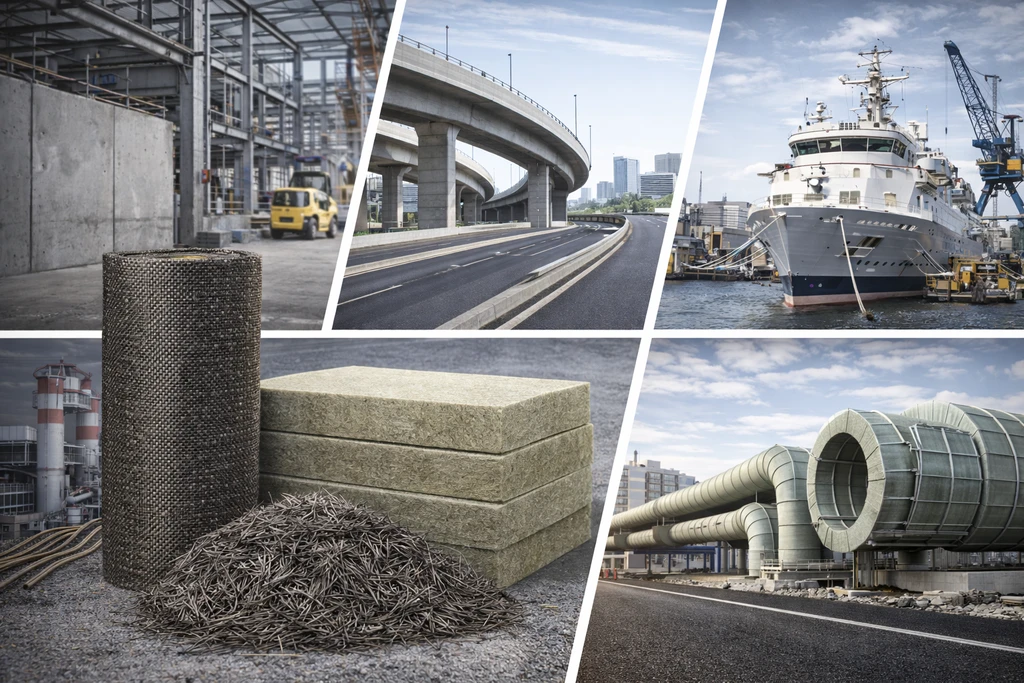
Modern industry and infrastructure increasingly prioritize solutions that combine reliability, safety, and long service life. For this reason, the use of basalt materials is viewed as a strategic direction for complex engineering and industrial tasks. These products form basalt composites capable of operating under high loads and aggressive environments, enhancing structural resilience and reducing operational costs.
Main types of basalt materials and their properties
Basalt materials represent a broad category of products derived from natural raw materials. Basalt, a volcanic rock, is processed into continuous fibers with specific characteristics. Based on these fibers, basalt fiber, basalt pipes, and basalt geogrid are produced — each designed to meet specific engineering needs. These materials offer resistance to chemical exposure, temperature fluctuations, and mechanical stress.
Their physical and mechanical properties make them suitable for use across multiple industries. High durability, stable performance, and mineral composition allow them to outperform traditional solutions in demanding environments. Manufacturing is guided by strict quality control at every stage, which is especially important for industrial and infrastructure applications.
Applications of basalt materials across industries
The broad range of properties makes basalt materials in Uzbekistan highly demanded in key economic sectors. In mechanical engineering, they are used to protect components and reduce vibration loads. In the chemical industry, they are applied where resistance to aggressive environments and equipment safety are critical. In aviation and railway infrastructure, they are valued for their low weight and resistance to temperature variations.
As a manufacturer of basalt composites, Basalt Uzbekistan provides solutions for the energy and transport infrastructure sectors. In these fields, basalt mesh and basalt pipes are used to reinforce structures, increase reliability, and reduce operational risks. These materials extend the service life of facilities and decrease maintenance costs.
Why basalt composites are chosen for large infrastructure projects
For large-scale projects, durability and safety are key criteria. Basalt composites demonstrate high resistance to loads and external factors. They do not corrode and maintain their properties under diverse climate conditions, which makes them an effective solution for construction and infrastructure upgrades.
The economic aspect is equally significant. The price of basalt materials reflects their long service life and reduced repair costs. As a result, project owners increasingly seek where to buy basalt composites for comprehensive infrastructure development.
How to purchase basalt materials and composites
Selecting the right supplier directly affects project outcomes. A reliable supplier of basalt materials ensures stable product quality and provides support throughout the procurement process. When purchasing, it is important to evaluate technical compliance, documentation availability, and logistics conditions. For large facilities, purchasing basalt materials directly from the manufacturer is often the most efficient approach.
Key considerations when planning a purchase:
- compliance with industry standards;
- experience in industrial project implementation;
- delivery and support terms;
- availability of comprehensive solutions for various industries;
- transparent conditions and consistent product quality.
Today, the sale of basalt composites is primarily oriented toward industrial and construction sectors, where each structural component plays a critical role. Using these materials enhances the performance and longevity of concrete and metal systems.